How Frankincense Resin Is Graded
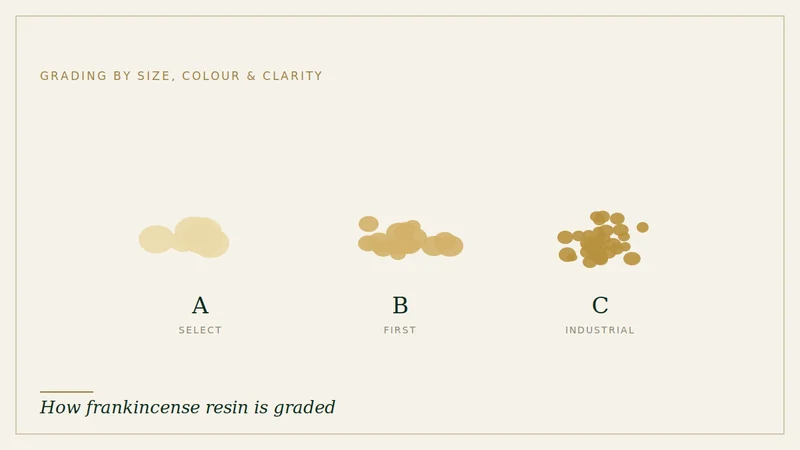
"Grade A" means little without a definition behind it. Frankincense grading is not standardised across the industry, so a serious supplier works to a written standard and can say exactly what each grade contains. Here is how grading generally works and how to specify what you need.
Why grading matters
Frankincense is a natural product; a single harvest yields everything from large, pale, whole tears to small siftings mixed with bark and dust. Grading separates that range into consistent, priceable categories. Without an agreed definition, quality can vary widely between shipments.
The grading criteria
The main criteria used to grade frankincense include tear size (larger whole tears rank higher), colour and clarity (pale, translucent tears typically rank above dark or opaque ones), and foreign matter (bark, dust and debris). Moisture is also relevant, since higher moisture can risk spoilage and inflate weight.
What A, B and C mean
| Grade | Typical profile | Typical buyer |
|---|---|---|
| A — Select | Larger, paler, whole tears | Fine fragrance, premium retail |
| B — First | Medium, whole & broken | Essential oil, cosmetics |
| C — Industrial | Small tears, siftings | Extraction, incense, industry |
Somali frankincense also carries traditional trade names — for example, a top Maydi grade is known as "Mushaad". A supplier should map these onto a clear A/B/C standard. These are indicative categories, not a universal international standard.
How to specify a grade
When ordering, specify the species, the grade, acceptable moisture and foreign-matter expectations, and the tear-size range. The more precisely you specify, the less room there is for dispute. See our wholesale Boswellia frereana and Boswellia carterii pages for how we present grades.
Verifying on arrival
Agree a pre-shipment sample of the actual lot, retained by both parties, and a clear quality-claim and rejection process. See our frankincense grading and documentation page, and our supplier checklist for European buyers.
References & further reading
- European Pharmacopoeia (Ph. Eur.), Council of Europe / EDQM — monographs and general test methods for loss on drying and volatile-oil determination. edqm.eu. Relevant to moisture and oil-content testing referenced here.
- International Organization for Standardization (ISO) — standards for essential oils and analytical methods (e.g. ISO 4720 and related). iso.org. Relevant to test-method references.
- General trade practice note: A/B/C grade names are commercial conventions, not a single international standard; buyers should define grade tolerances contractually. This reflects Horn Resins trade experience rather than a published standard.
External references are provided for background. They are not endorsements, and buyers should independently verify regulatory, botanical and safety information for their own market and application.