What European Buyers Should Request from a Frankincense Supplier
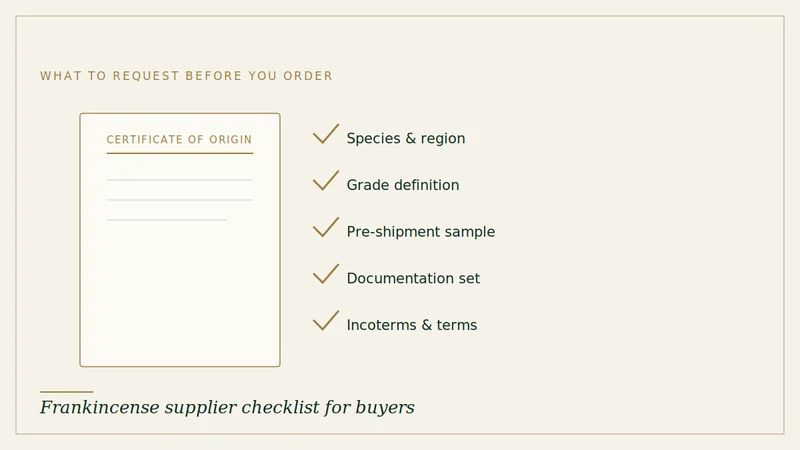
Sourcing frankincense from origin can deliver better quality and value than buying through intermediaries — but only if you ask the right questions. This checklist covers what a European buyer should request before committing to a frankincense or myrrh supplier.
Specifications to request
- Botanical species (e.g. Boswellia frereana vs carterii) and trade name.
- Region of origin within the country.
- Grade definition — tear size, colour, clarity.
- Moisture and foreign-matter expectations.
- Aroma profile and, where relevant, typical essential-oil yield.
- Harvest period and storage/shelf-life guidance.
Documentation to request
- Certificate of origin.
- Phytosanitary certificate.
- Certificate of Analysis (CoA) where required.
- Packing list and commercial invoice.
- Traceability information linking the lot toward its harvesting area.
- Where a certified operator is involved: organic, FairWild or Halal documentation, and SDS/TDS where relevant.
A credible supplier will describe which documents can accompany a shipment and which are available on request. Be cautious of certification claims that cannot be backed by a verifiable certificate holder, number and validity date.
Samples and approval
Request a representative sample, and agree that a retained pre-shipment sample of the actual lot defines the contract quality. This single step prevents most quality disputes.
Commercial terms
- Minimum order and lead time.
- Incoterms (FOB, CIF, DAP) and named port.
- Payment terms.
- Quality-claim and rejection process.
- Packaging format and labelling.
Red flags
Watch for suppliers who cannot name the species precisely, will not provide a pre-shipment sample, make certification claims without documentation, or quote a single "best price" with no grade definition. Traceability and documentation separate a professional supplier from a commodity reseller. See what we provide on our frankincense grading and documentation page, or request samples to start.
References & further reading
- International Chamber of Commerce (ICC) — Incoterms® 2020. iccwbo.org. Supports the delivery-term definitions (FOB, CIF, DAP) referenced here.
- International Plant Protection Convention (IPPC) — phytosanitary certification framework. ippc.int. Supports statements on phytosanitary certificates.
- European Commission — import rules for food and food-contact / cosmetic ingredients (ec.europa.eu). Buyers must confirm the rules applicable to their own product category and market before purchase.
External references are provided for background. They are not endorsements, and buyers should independently verify regulatory, botanical and safety information for their own market and application.