Boswellia Frereana vs Boswellia Sacra (Carterii): A Buyer's Guide
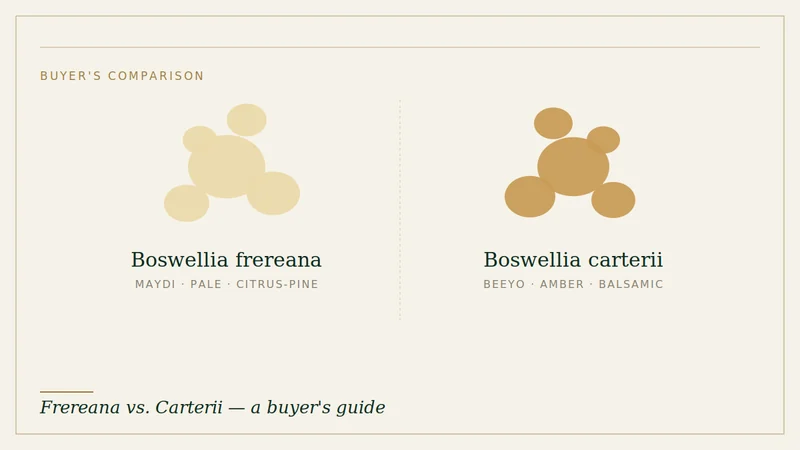
Buyers new to Somali frankincense sometimes treat "frankincense" as a single commodity. In practice, the two species that dominate Somali production — Boswellia frereana (Maydi) and Boswellia carterii (Beeyo) — behave differently in the bottle, the still and the formulation. This guide sets out the practical differences a professional buyer should understand.
The two species
Maydi (wholesale Boswellia frereana) grows mainly in the highlands of northern Somalia and is often described in the trade as a premium frankincense. Its tears are typically pale, translucent and relatively large.
Beeyo (Somali Boswellia carterii supply) — whose accepted botanical name is Boswellia sacra, very commonly traded under the synonym Boswellia carterii — is a widely used olibanum across the global fragrance and wellness industries. Its tears are typically golden to amber.
Botanical names and why the trade still says "carterii"
The naming is a common source of confusion for buyers. For Beeyo, the accepted botanical name is Boswellia sacra; the widely used trade name Boswellia carterii (also spelled carteri) is treated as a synonym by authorities such as Kew's Plants of the World Online [1]. The equivalence of African material (historically called carterii) and Arabian B. sacra has been debated, and some chemical studies have argued they behave as distinct types [4]. In practice, most commercial documentation still uses "carterii" because that is what buyers search for and what appears on much existing paperwork.
Maydi is a separate species, Boswellia frereana [2], not a grade or variety of the same tree. A frequent buyer error is treating all Somali frankincense as one product, or confusing B. frereana and B. carterii with the unrelated B. papyrifera from Ethiopia/Sudan. Always confirm the species on the Certificate of Analysis or specification, not just the trade name.
Chemistry and aroma
A commonly cited difference is boswellic-acid content: B. frereana is reported to contain little to no boswellic acid, while B. carterii contains boswellic acids [1][2]. In trade terms, frereana is often described as fresher and more citrus-pine, and carterii as warmer and more classically resinous. Aroma is subjective and varies by lot; buyers evaluating for a specific accord should assess samples directly.
| Attribute | Maydi — B. frereana | Beeyo — B. carterii |
|---|---|---|
| Boswellic acids | Reported little to none [1] | Present [2] |
| Typical aroma | Fresh lemon-pine | Warm balsamic-incense |
| Typical oil yield* | ~5–9% | ~3–7% |
*Yield ranges are typical industry observations that depend on material and distillation method; treat them as indicative, not guaranteed.
Oil yield and distillation
Distillers often value frereana for a comparatively pale oil and good yield, and carterii for the boswellic-acid content that extract and wellness buyers may specifically require. If your end product is a frankincense essential oil for fragrance, frereana is frequently preferred; if you need boswellic acids for an extract, carterii is the usual choice. Confirm the exact profile you need against lot-specific analysis.
Which to buy for which use
- Fine perfumery, premium incense: Maydi (B. frereana).
- Classic olibanum fragrance notes: Beeyo (B. carterii).
- Boswellic-acid extraction, wellness: Beeyo.
- Pale essential oil, high yield: Maydi.
What to confirm on the COA before ordering
Before placing an order, ask that the Certificate of Analysis or specification states, at minimum: the botanical species (not just the trade name), the region of origin, the grade and its definition, moisture and foreign-matter figures for the actual lot, and the harvest period. Anything presented as a general species property (aroma family, typical oil yield, boswellic-acid presence) should be treated as background, while lot-specific values belong on the COA. See our guide on how frankincense is graded and our quality and documentation page.
Sourcing notes
Because Maydi is grown in a narrower geography, grading matters — the difference between top-grade tears and mixed lots is significant. For both species, insist on a written grade definition, a pre-shipment sample of the actual lot, and clear documentation. See how we handle frankincense grading and documentation, or read our guide on how frankincense is graded.
References & further reading
- Plants of the World Online (POWO), Royal Botanic Gardens, Kew — Boswellia sacra Flück. (accepted name; lists Boswellia carteri Birdw. as a synonym). powo.science.kew.org. Supports the botanical naming used here.
- Plants of the World Online (POWO), Kew — Boswellia frereana Birdw. (accepted name). powo.science.kew.org. Supports the species distinction between Maydi and Beeyo.
- DeCarlo, A. et al. (2018), "Compositional analysis of the essential oil of Boswellia frereana…", and related Boswellia oil-composition studies indexed on PubMed (pubmed.ncbi.nlm.nih.gov). Support the general statements on oil composition; specific figures vary by study and lot.
- Note on synonymy: the equivalence of African B. carterii and Arabian B. sacra has been debated in the literature; POWO/World Flora Online currently treat them as synonymous, while some chemical studies have argued for a distinction (see ScienceDirect topic overview, "Boswellia sacra"). Treat species-level claims as taxonomy-dependent.
External references are provided for background. They are not endorsements, and buyers should independently verify regulatory, botanical and safety information for their own market and application.